Tuesday, 20 August 2013

Connecting the Dots part.1


What do the two images above have in common? The top image is by the Rev. Charles Dodgson - probably of one of the Liddell Children, possibly Edith - while the lower image was taken in the late 1970s by Robert Mapplethorpe of Rosie, the child of a friend. Both images have been and still are considered controversial and have been used to defame and bring about the downfall of their makers. The former after the artist's death in the overly-cautious, ultra-PC 1980s and 90s, while the latter, along with images by Andreas Serrano, had been used in order to justify a retraction of arts funding in New York City in the 1980s.

As most know, Charles Dodgson used his alter-ego Lewis Carroll to publish the children's books Alice's adventures in Wonderland and Alice Through the Looking Glass which were based on his favourite child-model Alice Liddell of Oxford and has, in recent years received a fair-bit of muck-raking over his images. These days many of these details are not only overblown and overworked but have become the stuff of generally accepted myth that is constantly weighed up alongside the more-recent weirdo-career of Michael Jackson, another adult who seemed to have a hard time existing in the adult world and promptly got his fair share of abuse for it.


Upon watching the excellent documentary Black, White and Grey, a portrait of Sam Wagstaff, Mapplethorpe's partner and an early avid collector of Victorian photography, I noticed with interest that Wagstaff had owned a copy of the above image and thought it interesting that Mapplethorpe may have seen this and have been inspired to make his image of Rosie. Mappplethorpe was a true artist who happened to work within the 2D picture-plane of photography and who could see and cause others to see the aesthetic beauty in controversial subjects and imagery.


In this respect, it does not seem too far of a jump to consider that not only would Maplethorpe have seen this image in Wagstaff's collection but that he would have been aware of the brewing controversy in Dodgson's images at this point in the 1970 and 80s (hard to think of a time that Dodgson's images were unknown to the general public but for many years they lay in the archives at Oxford among his papers, practically undiscovered) and related this to his own struggles as an artist and photographer exactly one hundred years later.


It strikes me that Mapplethorpe created the Rosie image to stir what he saw as the brewing hysteria in America of the fear of showing 'indecent' images of children. That he would want to take an image like Dodgson's and to its next logical state to suit our jaded and desensitised times seems like something which Mapplethorpe would do to excite a furore in his own work. 


Clearly a favourite image of Dodgson's and one that he repeated again and again, using younger children when subsequent ones were too old, I discovered similar images to the Liddell one above, featuring Xie Kitchin and other members of the Liddell family lying on sofa's and staring directly into the camera. Unlike the inherent inncoence embodied in Mapplethorpe's Rosie, there is an undercurrent of sexuality in all of the Dodgson images - the direct, active, gaze coupled with a passive pose is seen again and again in the nubile harem slave of many a Victorian Orientalist painting which were usurped so successfully in Manet's Olympia of 1863 - Manet highlighted the hypocrisy of Victorian society by painting a modern-day prostitute without the safety-net of iconography such as religion or metaphor employed by others - another work that is partly enthralling because it is constantly being questioned and reassessed (and copied and spoofed) by a new generation.


Unfortunately the over-protectiveness of our children in the 1980s has created a dichotomous culture in which we at once celebrate and mourn the flesh of youth. This particular aspect has been written far better and at much greater length elsewhere than I could ever do justice to, however it is the inherent innocence in an image like Mapplethorpe's Rosie that makes us question just what we are looking at. There is a direct gaze, sure, but the image is more in keeping with any one of Sally Mann's images of her own children taken in the early 80s - and which more than once shared a courtroom with Mapplethorpe's work. 


Having said that though, and although she has often been painted as such ('scuse the pun), Mann is no dummy, and as well as being an excellent photographer, certainly knows her Art-History......


Monday, 5 August 2013

London Alternative Photography Collective Inaugural Meeting.


This Thursday the 8th August see the inaugural meeting in what hopes to be a regular event exploring the history of photography and the application of alternative photographic processes, taking place at Double Negative Dark Rooms, 178A Glyn Road, Hackney, E5 0JE.

ALL WELCOME.

At 7pm, there will be informal talks from;

- Seb Sussman, founder of the Double Negative Darkrooms. http://www.sebsussmann.co.uk/

Processes Explored: Cyanotype Rex, Salt Printing, Gum, Copperplate photogravure, Lith Print, Pinhole, Slit Screen

- Gavin Maitland, photo historian, writer and curator who sometimes works at The Victoria and Albert Museum and Christies on digitization/catalogue projects. Gavin also runs the online social history archivehttp://www.arkpress.co.uk/

http://photohistoryrulesok.blogspot.co.uk/

Processes Explored: Wet Plate Collodion.

- Constanza Isaza Martinez, visual artist and researcher working primarily with photography, with a particular interest in historical photographic processes. Constanza recieved a first class BA degree in Photographic Arts from the University of Westminster.

http://www.constanzaisaza.com/

Processes Explored: Salts, Cyanotype,

The event is organised by Melanie K, visual artist experimenting with photographic processes. Melanie recently graduated from an MA in Art and Science at Central Saint Martins.

http://www.melaniek.co.uk/

Process explored: Cyanotype, Silver Gelatin, Daguerreotype

Wednesday, 10 July 2013

You get what everyone gets....


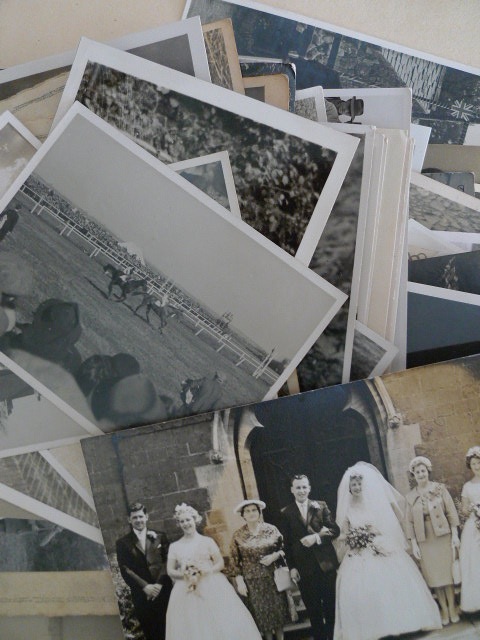
Lately, i've been working in one of the oldest dedicated photo-archives in the UK, if not the world. Part of my job within this particular archive (which shall remain nameless for reasons that will soon be apparent) is to sort the proverbial 'wheat from chaff' regarding anything that did not pertain directly to the history of the organisation in question. Upon doing this I duly discovered an entire shelf full of photo albums dating anywhere between the late nineteenth century and the 1960s that had nothing to do with the company in question. Questioning this, I was told that one of the previous archivists had had the bright idea to turn said archive into a picture library for British Social History sometime in the mid-1990s and had sequestered donations through national papers and magazines. The result that I had before me was the total result of all the donations and only a few were relatable to the organisation, which meant that I was free to either take them or chuck them. Having only very recently set up my online archive of British Social History; www.arkpress.co.uk/ I seized upon these images. Below are a series of what I had before me as I went through the stacks of envelopes.


Friday, 22 March 2013

Frightful Imprecations.


Photographing Prisoners.

On Saturday morning last a ludicrous scene was witnessed in the Preston Police Station. As is known, al persons charged with felony, etc, are compelled to have their photographs taken, so that the police authorities may “mark” them and  identify them in other places if ever they should offend again. Following out this practice, a female convicted of felony was was on Saturday ordered to stand in the Preston Police Station whilst hetr likeness was taken. But to this she evinced a decided repugnance, and threatened to knock the photographer and his appliances down if he attempted to take her portrait. The police insisted, and ashe as pertinaciously  reppelled their efforts, and threw herself upon her back on the  floor. On being raised up she drew her hair over her face, and swore they should not have her photograph. Seeing that persuasion was of no avail, the constables had to use violence, and whilst one clutched her firmly about the body another drew her hair back and held it  tightly behind her head. Though thus secured, she employed another means to defeat their purpose, and this was by making the most ludicrous grimaces and putting out her tongue. She would, she said, rather serve ten years penal servitude than than that they should take her photograph. The photographer, after repeated attempts, which occupied little short of and hour, succeeded in at last securing something like a normal likeness; and the woman, who continued to use frightful imprecations, was conducted to the police cell.

British Journal of Photography, November 2nd, 1877


Images from ledgers of police records dating to the 1870s found in an archive.....somewhere.

Wednesday, 20 March 2013

Ideologies.


There are bodies and spaces. The bodies – workers, vagrants, criminals, patients, the insane, the poor, the colonized races – are taken one by one: isolated in a shallow, contained space; turned full-face and subjected to an unreturnable gaze; illuminated, focused, measured, numbered and named; forced to yield to the minutest scrutiny of gestures and features. Each device is the trace of a wordless power, replicated in countless images, whenever the photographer prepares an exposure, in police cell, prison, mission house, hospital, asylum, or school. The spaces, too – uncharted territories, frontier lands, urban ghettos, working class slums, scenes of crime – are confronted  with the same frontality and easured against an ideal space: a clear space, a healthy space, a space of unobstructed lines of sight, open to vision and supervision;a desirable space in which bodies will be changed into disease free, orderly, docile and disciplined subjects; a space, in Foucoult’s sense, of a new strategy of power knowledge. For this is what is at stake in missionary explorations, in urban clearance, sanitary reform and health supervision, in constant, regularised policing – and in the photography which furnished them from the start with so central a technique.


What we have in this standardized image is more than a pictire of a supposed criminal. It is a portrait of the product of the disciplinary method: the body made object; divided and studied; enclosed in a cellular structure of space whose architecture is the file-index; made docile and forced to yield up its truth; separated and individuated; subjected and made subject. When accumulated, such images amount to a new representation of society.


From; Tagg, John, The Burden of Representation: Essays on Photographies and Histories, Basingstoke: Macmillan, 1988

Images from ledgers of police records dating to the 1870s found in an archive.....somewhere.


Monday, 18 March 2013

How Do You Get To Carnegie Hall? Part 1

...Practice, Practice, Practice - or so goes the joke.

I will be giving a paper at my first conference (or should that be 'my first paper at a conference' - or even 'my first paper anywhere!') in a couple of weeks and in that time honoured tradition I don't feel remotely ready yet I feel strangely unnervous about it. 

It is a conference called Devils and Dolls: Depictions of the Dichotomous Child and is being held at the University of Bristol (not Carnegie Hall, unfortunately), so it should feel all very proper and everything. I am giving a paper called (excitingly), 'Sentiment and Science: The 'Before and After' Child in the Barnardo's Children Photographs'. I added the 'Sentiment and Science' part recently because all the other speakers had really exciting titles and mine felt really dull.  


One thing I really hate in writing something is when you have all this STUFF and you know it all matters and its all appropriate but yo can't possibly SQUEEZE it into a 20 minute lecture and you don't even know where to begin and despite all the things that the internet can do it still can't invent a good program where you can see all your notes and images and stuff in an easy way like in the CSI and Law and Order where they start piecing together all the clues on a big clipboard and that coloured string gets EVERYWHERE and don't even get me started on Scrivener - I know it has a pinboard function but its crap, quite frankly, so I might as well actually resort to getting an actual, real clipboard from Wilkinson's and actually, really printing my images and quotes and bits off and sticking them all up on the actual, real clipboard in actual, real time and space and EVERYTHING.


So, in an effort to try to make sense of all the information and pictures I have I thought the best way to do it would be  to actually write my slides as blog posts and post them online - at least to give me a sense of what I am trying to do/say.
This strikes me as rather a good idea but in the meantime, I actually started working on individual slides and I think they are coming together a bit better. Sorting out how the images are gonna play helped me to think about what i'm going to say. 


Monday, 11 March 2013

Seaside Tintypes:

I went along to the London Photo Fair the other day. My heart wasn't really in it and I got there way too late but I did manage to pick up this nice seaside tintype for my ongoing research. Its hard to tell whether it really is an actual Tintype-taken-on-or-near-a-seaside but it was labelled as such and I think I see sand in the foreground and beach huts in the background. As with many seaside Tintypes - poor conditions, equipment, chemicals, etc - this didn't really speak to me 'til I scanned it in and started doing the old Blade Runner on it and it is really quite a nice image. Its a shame that many of these will never really be appreciated in their original state as to the naked eye they are just too murky, dark and/or fuzzy.


Here are a few more from my collection or whose images have been kindly lent to me for my research.


Probably 1870s. Kindly lent by James Downs.


1870s-1890s. Kindly lent by Paul Godfrey.


As can be seen in the next couple itinerants were more prevalent on the beaches of England well into the 30s and 40s until the film 'snappers' and 'walkies' started to come in (and that is a whole other area of study, namely the ever helpful Mr. Paul Godfrey's). These guys would have been old itinerants who most likely learnt their trade decades before. It is interesting that this short-lived format lasted so long on the beaches of England and Scotland (particularly Scotland for some reason), but as you can see from these, the results at the time were pretty shoddy - mostly due to using the cheapest of materials and chemicals - and they haven't aged the images well.


It seems that at some point in the 1920s somebody started marketing these card-stock sleeves and selling them to the tintypists. Whenever I find a seaside tintype dating after the '20s it will unfailingly have the same style card stock, even with the same designs.


Kindly lent by Paul Godfrey.

These later ones are ugly little things, but they stand as a precursor to the period when everyone had a Kodak or equivalent and for that they plug an interesting gap in our social history and of the little explored subject of the history of leisure in this country. As can be seen, these guys were opportunists, snapping people siting along piers or on the pebbles. I've even seen some of these that don't look like they were taken anywhere near a beach, but still fit into the category of leisure/holidays in some way.